About Atril and its author
Atril is a project by Eduardo Keser, tuba player and arranger in Yerba Buena, Tucumán (Argentina). I built the tools I wished I had when I was practising and playing in brass ensembles: a tuner that also explains why a note is out of tune.
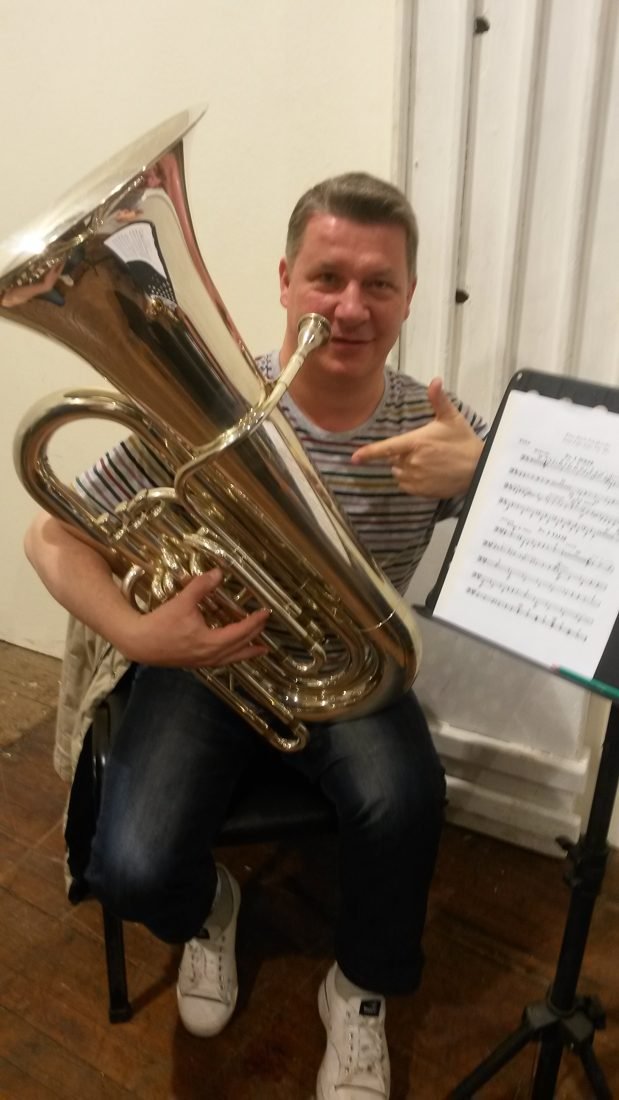
Who I am
I'm Eduardo Keser and I live in Yerba Buena, Tucumán (Argentina). I'm a brass musician: I play tuba, bass trombone and euphonium, write arrangements and, since 2016, I also clean and maintain brass instruments. Atril grew out of that: it's the set of tools I always wished I had on my music stand.
Training
I trained in Germany at the Hochschule für Musik Detmold (Dortmund campus), where I graduated as a music teacher and bass trombone teacher (the German title is «Staatlich geprüfter Musikschullehrer») and studied orchestral conducting. I took trombone masterclasses with Hugo Gervini, Henry Bay, Heinz Fadle, Ben van Dijk and Vinko Globokar.
Years in Germany (1994 to 2007)
Between 1994 and 2007 I studied, played, conducted and taught in Germany: brass bands and brass choirs, big bands, tango ensembles such as «Pasión de Buenos Aires» and the trombone quartet «Trombolatin». I grew up studying at the Colegio Alemán in Temperley and I speak German.
Back in Argentina
In 2008 I was second trombone of the resident orchestra of the Teatro Colón, and since 2009 I have been the tuba player of the Orquesta Estable de la Provincia de Tucumán. I played and arranged for the Tucumán Brass Quartet and Quintet, and in 2017 and 2018 I founded and directed the Ensamble de Metales Tucumán. From 2022 I was tuba player of the Banda Municipal of San Miguel de Tucumán. For years I taught trombone, tuba and music management at conservatories and at the Escuela Superior de Educación Artística de Tucumán. Since August 2025 I have left teaching and I am attached to the Provincial Symphonic Band.
A tango book for brass
In 2015 my book «Tango Argentino», an arrangement for brass ensemble, was published in Germany. The sheet-music shop listing is in the «In the media» section below.
In the media
- La Gaceta (Tucumán), 19 November 2017. The article «Metales preciosos, pero de viento y con sonido brillante en La Semana de la Música» presents the Ensamble de Metales Tucumán: according to the paper, eleven players (trumpets, French horns and trombones), unique in Tucumán and possibly in the region, with a repertoire from the classics to tango, and me as its director. Read the article at La Gaceta (in Spanish).
- Notenlager (sheet-music shop, Germany). The listing for «Tango argentino: für Blechbläser» (Windspiel Musikverlag, score in C) names me as arranger and lists tangos and milongas such as «El choclo», «El entrerriano» and «Nueve de julio», plus «Valedy», which I wrote. See the listing at Notenlager (in German).
Third-party sources, summarised in my own words; the photos on those pages are not reproduced.
Transparency: artificial intelligence is my new hobby. I prepare the texts on this site with the help of AI and publish them under my own responsibility; if you spot a mistake, please write to me.
What we do
- Tools that run in the browser with nothing to install: tuner, intonation X-ray, metronome, drone, transposer and fingering charts.
- Our own guides for musicians on tuning, practice and instrument care.
- Historical data on pitch and tempo, with sources, in the history of pitch and tempo.
How the tools work
The tuner detects pitch with the McLeod method (a variant of autocorrelation) right in your browser. Microphone audio is never recorded or sent to any server. Frequencies are computed in equal temperament from the reference A you choose. The tools are in Spanish, English and German with the same content in all three.
Where the data and texts come from
The guide texts are our own writing, and numeric data (frequencies, cents, wavelengths) is calculated with standard formulas. Historical data rests on sources cited on each page (for example Quantz, 1752, and Bruce Haynes, A History of Performing Pitch). When a figure is approximate we mark it as such. If you find a mistake, write to us and we will correct it.
How we are funded
The tools are free. The site shows Google AdSense ads and links to the brass ensemble sheet music at EBK Brass. If the tools help you, you can also buy us a coffee. Ads do not influence the content.